

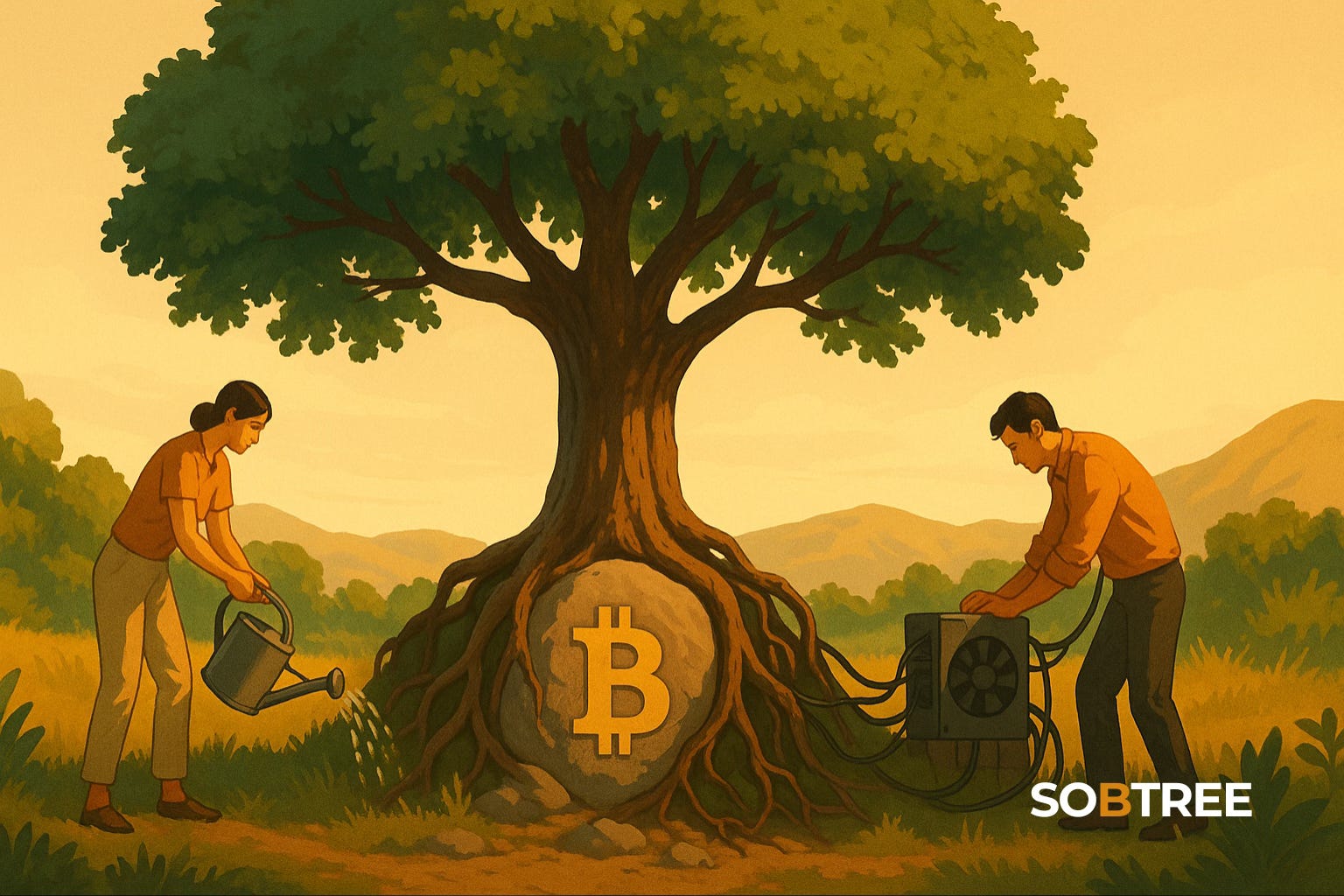
At Sobtree, many people ask why we combine two seemingly opposite strategies: mining Bitcoin and buying spot Bitcoin. The answer is not that one is always better than the other. It’s that each has its place, depending on your context, resources, treasury goals, and risk appetite. What I want to share here is an honest, simplified analysis of when mining makes sense and when buying is the superior strategy if your goal is to accumulate as much BTC as possible, either for your company or your personal balance sheet.
Why “just mine” or “just buy” are both bad answers
Because mining Bitcoin adds an extra layer of complexity. Your returns don’t only depend on the price of Bitcoin they’re also tied to operational costs, network difficulty, energy efficiency, and hardware maintenance. When you buy Bitcoin, you’re making a direct bet on price. But when you mine, you’re “buying hashrate” with electricity, not buying BTC outright. This turns mining into something closer to a financial option: you’re betting that the value of hashrate (what it costs to mine 1 BTC) will evolve favorably compared to the BTC price.
In many cases, mining can be cheaper than buying spot but that doesn’t automatically make it the smarter option.
The key variables that determine whether mining is worth it
For mining to make sense, a few things need to line up:
Electricity costs: by far the most important variable
Hardware efficiency: the more efficient the machine, the cheaper each hash
Network difficulty: higher difficulty means lower BTC output
Bitcoin price: if BTC drops, mining might become unviable in fiat terms
Extra operational costs: cooling, hosting, repairs, taxes
If any of these aren’t optimized expensive electricity, outdated hardware, rising competition then buying Bitcoin is often a more efficient way to stack sats.
Real-world example: mining vs buying with €75,000
Let’s consider a concrete scenario: today, 1 BTC in the spot market costs €75,000, and with optimized infrastructure (cheap electricity, pro hosting), the cost of mining 1 BTC is around €8,000.
So what can you do with €75,000?
Strategy 1: Buy BTC directly
You invest €75,000 today
You receive 1 BTC immediately
No ongoing costs, minimal operational risk
Full liquidity and simplicity
Result: 1 BTC in your treasury instantly
Strategy 2: Mine BTC with that capital
You invest part in ASIC hardware, part in operations (electricity, hosting, maintenance)
Over the next 3–4 years, you can mine 1.5 to 2.5 BTC, depending on network difficulty and BTC price evolution
Costs are spread over time
You face logistical and operational risks
Estimated result: ~2 BTC net over several years
Here’s the hidden upside of mining: if you can turn those €75,000 into 2 BTC mined over time, you’re effectively acquiring Bitcoin at an average cost of €37,500 per coin, well below the spot price today. But that requires patience, execution, long-term vision and operational resilience.
Why at Sobtree we do both
Because we understand that a Bitcoin-first treasury system should never rely on a single method. We combine buying and mining for strategic reasons:
Mining lets us convert operational expense into BTC
It gives us access to non-KYC Bitcoin, fully outside the banking system
When structured properly, it allows us to finance new projects with mined BTC
Buying provides liquidity, simplicity and immediate exposure
Mixing both strategies reduces risk, improves timing, and optimizes the balance sheet
There’s also a layer most people overlook, and here I’ll share it openly: if you operate mining through a limited company in Spain (SL), you can depreciate the hardware, deduct electricity, and reinvest the BTC mined into legal financing channels. Same applies to holding structures in Malta or Estonia, or a personal structure based in Panama with optimized tax residency.
When is it better to buy, and when to mine?
Buying is usually better when:
You don’t have access to cheap energy
You don’t want to deal with hardware or regulation
You want simplicity, liquidity, and clean exposure
You’re optimizing for speed and low friction
Mining makes sense when:
You can access low, stable energy prices
You want to convert expenses into Bitcoin
You’re building an income-producing BTC engine
You’re comfortable with technical and operational complexity
You’re thinking in cycles, not weeks
Conclusion: accumulating BTC is not just about buying
Mining is a way to generate Bitcoin actively through controlled expenses and structured planning. Buying is the clean, direct path but also the one most dependent on perfect timing. We use both because our goal is to build an anti-fragile Bitcoin treasury that doesn’t rely on just one vehicle. If you want to build true financial freedom, you must think like an operator, not just an investor.
So now the question is: how many sats do you want to own by 2030?
Will you buy them or will you manufacture them?
Can you please recommend some resources where or individuals or small companies could begin mining?